Product detail page redesign
·
2026
An evolving product page redesign focused on clearer product information, easier size selection and a smoother path to purchase.
Hawes & Curtis
·
CRO & UX Lead / UX & UI Design
Overview
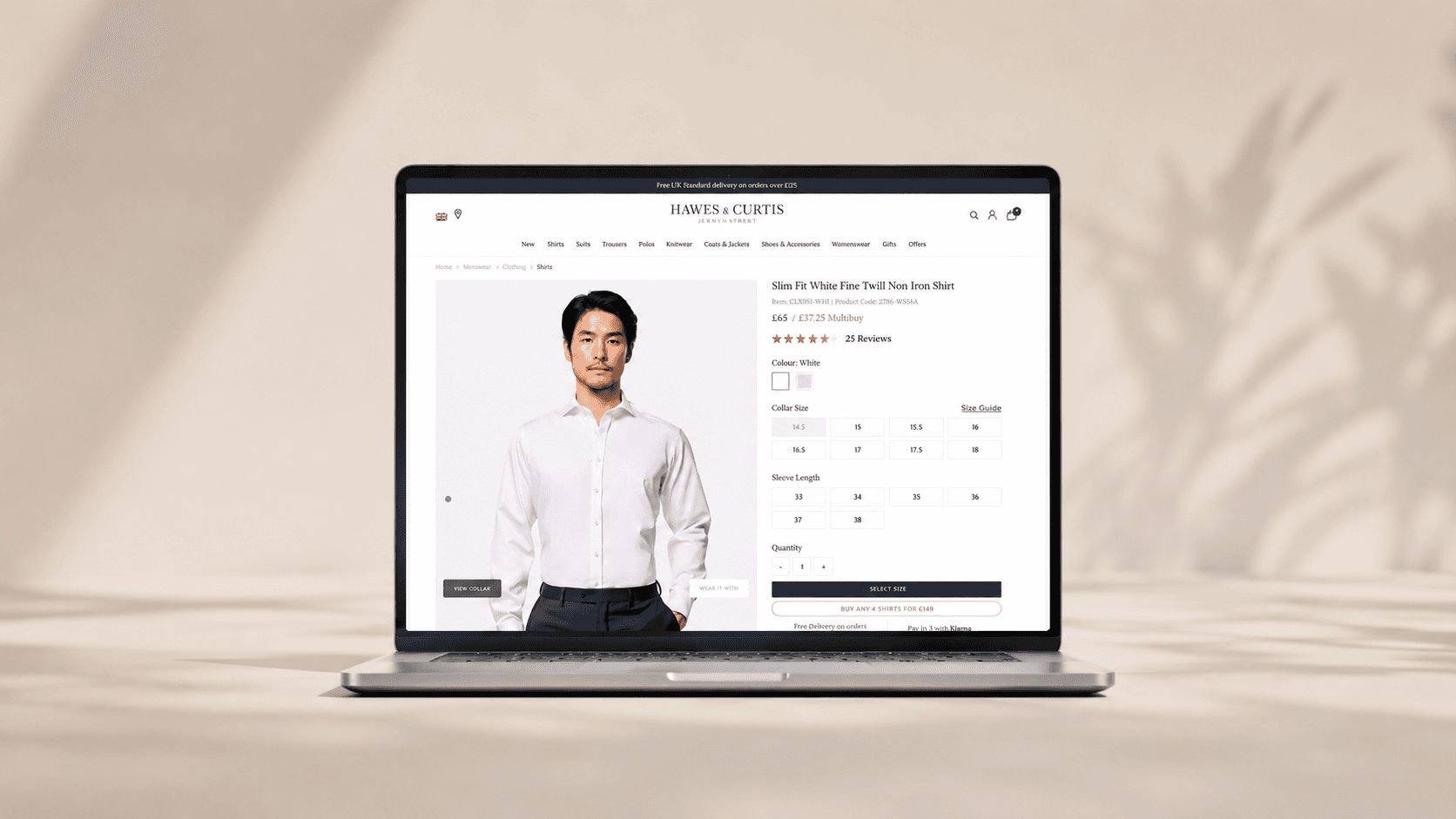
The Hawes & Curtis PDP redesign is an in-progress UX and UI project focused on improving one of the site’s most important commercial templates.
The work explores how customers evaluate products before adding to bag, with early iterations looking at product imagery, colour selection, size guidance, product details, reviews, multibuy messaging and “Wear it With” recommendations.
Because the redesign is not live yet, the case study focuses on the thinking, structure and early design direction rather than final results. It shows how I approach PDP improvement as a commercial UX challenge: reducing hesitation, improving clarity and helping customers make more confident product decisions.
At a glance
Client
Hawes & Curtis
Role
CRO & UX Lead / UX & UI Design
Focus
PDP UX · Mobile conversion · Product confidence
Tools
Figma, GA4, Hotjar, stakeholder collaboration, development handoff
Output
Early responsive PDP redesign iterations
Year
2026
Disciplines
UX Design, UI Design, eCommerce, CRO, PDP Design, Mobile UX
Status
In progress
Context
The product detail page is one of the most important commercial moments in an eCommerce journey. By the time a customer reaches a PDP, they are actively evaluating a product — but small points of friction can still create hesitation.
For Hawes & Curtis, the opportunity was to review how product information, imagery, size selection, colour options, reviews, multibuy messaging and recommendations were working together.
The redesign explored how the PDP could feel clearer, more confident and easier to use, particularly on mobile where space is limited and decision-making needs to feel effortless.
01
The challenge
The existing PDP had to support several important customer decisions at once: product evaluation, image browsing, colour choice, size selection, product details, reviews, promotion awareness and cross-sell discovery.
The challenge was that these decisions were not always supported in the clearest order, especially on mobile. Some useful information could be missed, while other key actions required more effort than they needed to.
The redesign needed to make the PDP clearer and more commercially effective without making the page feel busy or overloaded.
hawesandcurtis.co.uk


02
What it needed to do
01
Improve product clarity at the point of consideration
02
Make size, colour and product details easier to act on
03
Increase confidence through better information hierarchy
04
Create a sprint-ready foundation for PDP optimisation
03
My role
As CRO & UX Lead, I shaped the PDP redesign from early analysis through to design exploration and stakeholder review.
Reviewed the existing PDP experience and identified key friction points
Explored mobile and desktop layout improvements in Figma
Defined the first sprint of proposed PDP changes
Created annotated design recommendations for stakeholder alignment
Considered responsive behaviour across mobile and desktop
Worked through product information hierarchy, interaction states and content placement
Prepared the work for development discussion and phased delivery
Responsive
Adapts to various product type

Desktop ·

Mobile ·
Commercial thinking
Reducing hesitation on the path to add to bag
The redesign was shaped around the idea that a PDP should reduce hesitation, not create more decisions for the customer to work through.
Rather than treating the page as a simple product information template, the work focused on the buying decisions a customer needs to make: do I like the product, is it available in my size, what colours are available, what offer applies, can I trust the quality, and what else works with it?
Product imagery was prioritised to create stronger visual confidence
Colour and size selection were kept easier to find and act on
Product details were made more accessible earlier in the journey
Reviews and reassurance were brought closer to the decision-making moment
Cross-sell recommendations were designed to support outfit building and basket growth
Promotional messaging was treated as a useful decision cue, not a separate marketing layer
04
Outcome
The project is currently at early iteration stage and has not yet launched, so there are no performance results to report.
The work has created a clearer direction for how the Hawes & Curtis PDP can evolve through practical, sprint-based improvements.
A clearer PDP structure for mobile and desktop
Early design iterations focused on product confidence and decision-making
A proposed first sprint of PDP improvements
Stronger visibility of colour, size, details, reviews and recommendations
A more considered approach to balancing product content, promotion and cross-sell
A foundation for future testing and post-launch optimisation
05
What I’d improve next
Because this work is not live yet, the next step would be to validate the design through stakeholder feedback, development review and post-launch measurement once released.
The strongest next move would be to define exactly which changes are included in the first build sprint, then measure the impact on PDP engagement, size interaction, add-to-bag rate, recommendation clicks and mobile conversion behaviour.
Validate the first sprint with stakeholders and development
Test interaction states before build
Track size guide clicks, colour selection and add-to-bag behaviour
Measure “Wear it With” engagement once live
Review mobile scroll behaviour after launch
Continue improving the PDP through smaller, measurable iterations

